E-commerce / Apparel
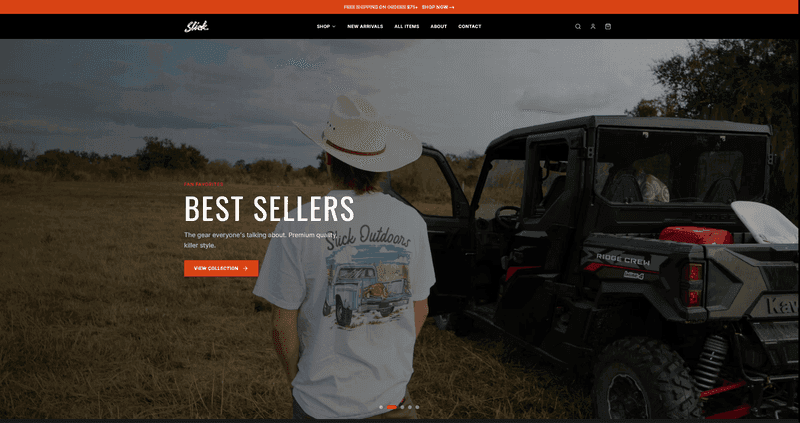
The Slick Stevie
A custom-built Shopify storefront for an apparel brand, where the theme carries the identity and checkout stays on Shopify’s own flow.
Read the case studyShopify Development
Shopify development is the work of building a store’s theme and storefront in code rather than configuring a purchased template until it almost fits. It covers custom Liquid templates for products, collections, and landing pages, the cart and checkout experience Shopify lets you control, app integrations, and migrations from platforms like WooCommerce or Squarespace. You keep everything Shopify handles — payments, inventory, orders, PCI compliance — and replace only the storefront your customers actually see.
Fit
You bought a marketplace theme, paid for four apps to patch its gaps, and now the store looks like every competitor while being slower than all of them.
Bundles, variant-specific imagery, size guides, made-to-order lead times, or collections that need to be curated by hand rather than sorted by an automatic rule.
You are moving off WooCommerce, BigCommerce, or a custom cart, and you need products, customers, and URLs to arrive intact rather than as a spreadsheet nobody trusts.
A Kalamazoo shop with real inventory and repeat customers, where the online store has to reflect what is actually in stock and support local pickup alongside shipping.
Why it matters
Deliverables
Process
STEP 01
We go through your products, variants, and collections, the apps you actually rely on, and how orders are fulfilled. That determines which templates the theme needs and what has to be migrated or rebuilt.
STEP 02
Homepage, collection, product, and cart are designed as a sequence rather than four separate screens, because the questions a customer asks on a product page decide whether the cart is ever opened.
STEP 03
The theme is written in Liquid against a development store loaded with your real products, so you review actual merchandising with real photography and pricing rather than placeholder items.
STEP 04
Products and customers move over, redirects are mapped, and test orders run through payment, shipping, and confirmation emails end to end. Then the theme is published and your team is walked through editing it.
Stack
Most custom Shopify theme builds run roughly five to nine weeks from kickoff to launch, and stores migrating from another platform typically take longer because the data has to be cleaned before it moves. Catalog size matters less than catalog complexity — two thousand simple products are usually easier than two hundred with bundles and conditional options. Product photography and copy are the two things that most often set the real launch date.
Theme builds are quoted as a fixed project price once we have seen your catalog and your current store, so you approve the number before work starts. The estimate is driven by how many distinct templates the design calls for, how complex your variants and merchandising rules are, and how much data has to be migrated. Shopify’s own subscription and any apps you choose to keep are billed by them directly, not marked up through us.
FAQ
Last reviewed
Tell us what you are building. We will reply with a scoped proposal — timeline, approach and pricing — so you can decide with real information.